According to Arthur Danto Art Is Over Because Artists Have
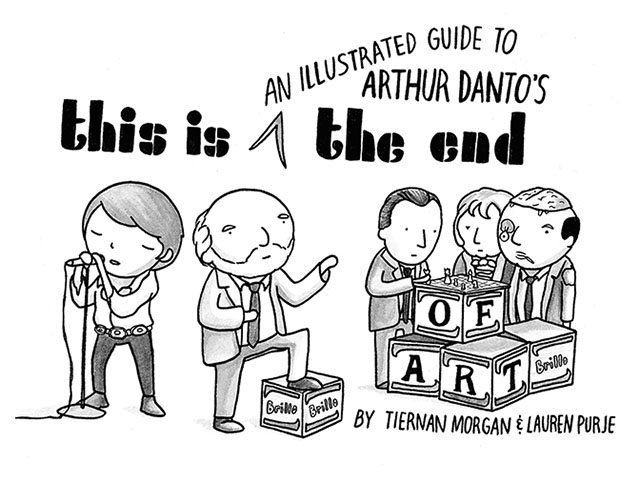
In an obituary for the New York Times, Ken Johnson described Arthur Danto (1924–2013) equally "one of the most widely read art critics of the Postmodern era." Danto, who was both a critic and a professor of philosophy, is historic for his accessible and affable prose. Despite this, Danto's best-known essay, "The End of Fine art," continues to be cited more than it is understood. What was Danto's argument? Is fine art really over? And if so, what are the implications for fine art history and art-making?
Danto's twin passions were fine art and philosophy. He initially embarked on a career as an artist (much of his work is now part of the Wayne Land University art collection) before pursuing an bookish career in philosophy. In 1951, Danto began educational activity at Columbia Academy, earning his doctorate the next year. He was an art critic for The Nation betwixt 1984–2009 and was a regular correspondent to publications such as Artforum.
In 1964, Danto visited an exhibition of Andy Warhol's Brillo boxes at the Stable Gallery, New York. The bear witness inverse his life.

Arthur Danto and Andy Warhol
It wasn't Warhol's field of study affair that shocked the philosopher, but its form. Whereas Warhol'due south paintings of coke bottles and soup cans were visual representations, the artist'due south Brillo box sculptures — silkscreened plywood facsimiles of actual Brillo boxes — were well-nigh indistinguishable from the existent thing. If one placed 1 of Warhol'due south sculptures beside a real Brillo box, who could tell the difference? What made ane of the boxes an artwork and the other an ordinary object? Danto outlined his conclusions in an essay entitled "The Artworld" (1964):
What in the cease makes the difference between a Brillo box and a work of art consisting of a Brillo box is a certain theory of art. It is theory that takes it upwards into the earth of art, and keeps it from collapsing into the real object which it is. [Warhol'southward Brillo boxes] could non take been art l years ago. The world has to be prepare for sure things, the artworld no less than the existent 1. It is the office of creative theories, these days equally always, to make the artworld, and art, possible.
Substantially, Warhol's Brillo boxes are art because the work has an audience which understands information technology via a sure theory (to use Danto'south term) of what fine art can exist. The artworld (comprised of critics, curators, collectors, dealers, etc.) plays a function in which theories are embraced or snubbed. Equally Danto surmises, "To see something as art requires something the eye cannot descry — an atmosphere of creative theory, a noesis of the history of art: an artworld." This idea, later expanded upon by the philosopher George Dickie, is too popularly known equally the institutional theory of fine art. The question lingering in the background is how and why these then-called theories modify and develop over fourth dimension.
Danto was fascinated by historical change. What made Warhol's Brillo boxes acceptable as art in 1964? What would Neo-classical painter Jacques-Louis David accept idea of Warhol'south work? How would Leonardo da Vinci, Phidias, or a caveman react? Do the Brillo boxes represent some sort of art historical progress? Was art history heading in a discernible direction? Danto's investigations into history, progress, and art theory, coalesced into his best-known essay, "The Cease of Art."
Before tackling "The End of Art," nosotros need to briefly consider how the history of fine art is traditionally understood.
Art history is generally thought of every bit a linear progression of one movement or style later another (Romanticism, Realism, Impressionism, Post-Impressionism, etc.), punctuated by the influence of individual geniuses (Delacroix, Courbet, Monet, Cézanne … ).
This primal approach is the visual basis of Sara Fanelli's twoscore-meter-long timeline of 20th-century fine art (which was formerly displayed on the Tate Modernistic's second floor). The timeline pinpoints the historical inception of particular movements, while besides naming primal historic artists (note how Fanelli'southward timeline trails off after the year 2000. Nosotros'll come back to this afterwards).

An illustration of Sara Fanelli's Tate timeline
Fanelli's timeline is office of a long tradition of attempting to visually map historic progression, a nebulous and tricky concept. The offset director of the Museum of Mod Art, Alfred Barr, famously designed his own timeline of 20th-century art, every bit did George Maciunas, the founder of Fluxus (Maciunas was really into diagrams; he reportedly spent 5 years on his incomplete 6 x 12–foot art historical timeline). These timelines oft implicitly back up certain ideas about what fine art is, what information technology was, and where it'south headed. I such concept that appears regularly throughout the history of art (albeit, in varying forms), is mimesis: the imitation and representation of reality.
Fine art historians have long argued that the ancient Greeks sought to imitate the human body with ever greater degrees of verisimilitude, a model that was resurrected during the Renaissance. This concept holds that artists should seek to master the faux of reality (the story of the painting contest between Zeuxis and Parrhasius typifies this ideal). A number of early on art historians sought to demonstrate how diverse artists had progressed (and in some cases, stunted) this ultimate goal, and in doing so, engineered i of the dominant narratives of art history. The consequence is a basic (and very reductive) estimation of art history. Summed up crudely, it resembles something similar this: The craftsman of the and so-called Dark Ages 'forgot' the mimetic skills and values of the ancients. Classical ideals were so resurrected during the Renaissance and were constantly reevaluated up to the late nineteenth century. By the early on 20th century, art had fractured into a multitude of concurrent movements.
The story Danto tells in "The End of Art" follows on from this model. Co-ordinate to Danto, the commitment to mimesis began to falter during the nineteenth century due to the rise of photography and film. These new perceptual technologies led artists to abandon the faux of nature, and every bit a event, 20th-century artists began to explore the question of art's own identity. What was fine art? What should it practise? How should fine art exist defined? In request such questions, fine art had go self-conscious. Movements such as Cubism questioned the procedure of visual representation, and Marcel Duchamp exhibited a urinal equally an artwork. The twentieth century oversaw a rapid succession of different movements and 'isms,' all with their own notions of what art could be. "All there is at the end," Danto wrote, "is theory, fine art having finally become vaporized in a dazzle of pure idea nigh itself, and remaining, as it were, solely as the object of its own theoretical consciousness."

Marcel Duchamp
Warhol's Brillo boxes and Duchamp'due south readymades demonstrated to Danto that art had no discernible management in which to progress. The grand narrative of progression — of i movement reacting to another — had ended. Art had reached a mail-historical state. All that remains is pure theory:
Of course, in that location will get on existence art-making. But art-makers, living in what I similar to call the post-historical period of art, will bring into beingness works which lack the historical importance or pregnant nosotros accept for a long fourth dimension come to await […] The story comes to an end, but not the characters, who live on, happily always subsequently doing any they do in their post-narrational insignificance […] The age of pluralism is upon the states…when one direction is equally good as another.
In retrospect, it'due south piece of cake to meet how Danto began to approach this determination during the 1960s. Movements such as Pop art and Fluxus were actively breaking downwards the barriers between art and the everyday. Relativist philosophies such every bit poststructuralism and existentialism were in full swing, critiquing the narratives and certainties which Western academia had previously held beloved. Having blown open up the definition of what information technology could be, fine art had undermined its ain belief in linear progression. Later on all, what movement or 'ism' could logically follow the dematerialization of the art object (conceptualism) or the pervasive skepticism of g theories and ideologies (postmodernism)?
Danto believed that any subsequent movements were nonessential in that they would no longer contribute to the pursuit of fine art's self-definition. "Nosotros are inbound a more stable, more happy catamenia of artistic endeavour where the basic needs to which fine art has ever been responsive may again be met," he wrote. Although Danto claimed the cease of fine art wasn't in itself a bad thing, he all the same appeared to later lament its demise. In his review of the 2008 Whitney Biennial, Danto lambasted the themeless state of the artworld. "It is heading in no direction to speak of," the philosopher wrote.
Whilst devising "The Stop of Fine art," Danto was "astonished" to turn to one of the unlikeliest of sources, the philosophy of Georg Wilhelm Friedrich Hegel (1770–1831).

Arthur Danto and Georg Wilhelm Friedrich Hegel
Hegel'southward philosophy was not in vogue during the '60s, but his teleological understanding of historyserved equally a useful template for Danto's conclusions. Hegel understood progress every bit an overarching dialectic — a procedure of self-realization and understanding that culminates in pure knowledge. This state is ultimately accomplished through philosophy, though it is initially preceded by an interrogation into the qualities of religion and fine art. As Danto summarized in a later essay entitled "The Disenfranchisement of Art" (1984):
When art internalizes its own history, when it becomes self-conscious of its history equally it has come to be in our time, so that its consciousness of its history forms part of its nature, it is perhaps unavoidable that information technology should plow into philosophy at last. And when it does so, well, in an of import sense, art comes to an terminate.
Danto is not the but philosopher to have adopted an Hegelian dialectic. Both Francis Fukuyama and Karl Marx utilized Hegelianism to reach their own historical conclusions. Fukuyama argued that liberal democracy and free marketplace capitalism represented the zenith of Western civilization, whilst Marx argued that communism would supercede commercialism (neither of these developments have quite panned out).
Sara Fanelli's timeline appears to validate Danto'south conclusions. After the year 2000, in that location are no movements or -isms, merely individual artists. The movements that are listed towards the end of the century aren't really movements at all. The term "YBA" (Young British Artists) is a useful catch-all for a various group of artists, some of whom happened to go to the aforementioned school (Goldsmiths). Also, "installation" is not a movement simply a means of presenting art. Recent terms such as "zombie ceremonial" (aka zombie abstraction) announced to confirm that nosotros are living in an age of mail-historical malaise.

(Zombie) Cloudless Greenberg
Though widely read, Danto's theories are not wholly love by the art industry. Artists don't necessarily want to hear that their work has no developmental potential. Danto'south work as well presents a challenge for the art market place which relies on perceived historic importance as a unique selling betoken. He predicted that the demand on the market place would crave the "illusion of unending novelty," later citing 1980s Neo-Expressionism as an example of the industry's demand to continually recycle and repackage prior aesthetic forms and ideas, a charge that parallels the contemporary contend regarding zombie ceremonial.
Danto'due south critics typically claiming the philosopher's reliance on traditional art historical models. In Danto and His Critics (get-go published in 1993) Robert C. Solomon and Kathleen M. Higgins hash out the "fallacy of linear history," namely that our pre-dominant fine art historical narratives are largely a product of their retelling:
As a person (or a culture) gets older, the story gets solidified and embellished in the retelling; and of grade, it gets longer. Early incidents and events are recast with forward-looking meaning they could not have possibly have had at the time.
If 1 rejects the developmental, Western art narrative that Danto describes in "The End of Art," then the structure required for Danto's Hegelian understanding of art collapses.
Information technology's important to recognize that fine art history is largely built upon the biases and subjective opinions of others. Giorgio Vasari (1511–1574), the so-called father of art history and author of The Lives of the Most Excellent painters, Sculptors, and Architects (1550), famously favored Florentine artists over those working in Northern Europe. Over the class of the twentieth-century, the art historical perspectives of academics such as Ernst Gombrich, Heinrich Wölfflin, and Erwin Panofsky were rigorously reassessed. Classical scholars have since problematized the mimetic interpretation of ancient Greek fine art. Most contemporary medieval scholars pass up the term "Dark Ages" for example, since information technology is implicitly judgmental and ignores the fact that early Christian fine art had a completely different set up of aesthetic priorities. The history of art becomes far more nuanced and complex when studied in microcosm. When ane considers the wealth of methodologies available to art historians (iconography, semiotics, psychoanalysis, and and then forth), Danto'southward conclusions wait all the more narrow and reductive.
Danto as well conveniently excludes work which challenges his art historical thesis, namely non-Western art. How exercise Japanese printmakers — whose perspectival and mimetic priorities differed radically from Western standards — fit into Danto's fine art historical narrative? Danto does mention Japanese prints in "The End of Art," although the question of how they affect his developmental interpretation of fine art history is completely sidestepped. "We take to make up one's mind whether [Japanese impress makers] had a unlike pictographic culture or simply were retarded by technological slowness in achieving solidities," Danto wrote.

Despite these criticisms, Danto'due south supporters argue that his theories are vindicated by a perceptible lack of direction in the art world. It could be argued that Danto'south conclusions hold up, even after one dispenses with his Hegelian framework. Has fine art but paralyzed itself past overanalyzing the class of history? How can nosotros always fairly predict the future from the vantage of the nowadays? Danto directly addresses this dilemma at the starting time of "The End of Art":
In 1952, the nigh avant-garde galleries were showing Pollock, De Kooning, Gottlieb, and Klein, which would have been temporally unimaginable in 1882. Null so much belongs to its ain time as an age's glimpses into the future: Buck Rogers carries the decorative idioms of the 1930s into the twenty-first century … the science fiction novels of the 1950s projection the sexual morality of the Eisenhower era […] The futurity is a kind of mirror in which we can show but ourselves, though it seems to us a window through which we may see things to come up.
Or equally Danto quotes Leonardo da Vinci, ogni dipintore dipinge se ("every painter paints himself").
Source: https://hyperallergic.com/191329/an-illustrated-guide-to-arthur-dantos-the-end-of-art/
0 Response to "According to Arthur Danto Art Is Over Because Artists Have"
Post a Comment