Single House Family for Sale in Chicago Il
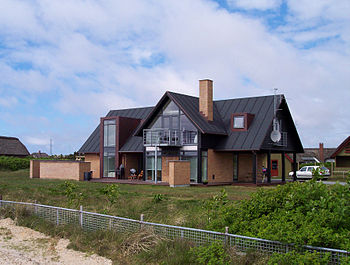
A stand up-alone house (also called a unmarried-detached dwelling, discrete residence or detached house) is a free-standing residential edifice. It is sometimes referred to as a unmarried-family home, every bit opposed to a multi-family residential dwelling house.
Definitions [edit]
A unmarried detached abode contains only one habitation unit and is completely separated by open space on all sides from any other structure, except its ain garage or shed.
—Statistics Canada[i]
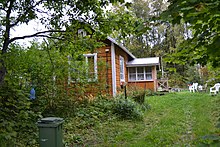
A small discrete house surrounded by a green chiliad in Haapamäki, Keuruu, Finland
The definition of this type of firm may vary betwixt legal jurisdictions or statistical agencies. The definition, withal, generally includes two elements:
- Single-family (habitation, house, or dwelling) means that the building is normally occupied by just one household or family, and consists of just one dwelling unit of measurement or suite. In some jurisdictions allowances are made for basement suites or mother-in-law suites without changing the clarification from "single family". Information technology does exclude, even so, whatever short-term accommodation (hotel, motels, inns), large-calibration rental accommodation (rooming or boarding houses, apartments), or condominia.
- Discrete (house, home, or dwelling) ways that the building does non share wall with other houses. This excludes duplexes, threeplexes, fourplexes, or linked houses, as well equally all row houses and most especially tower blocks which can hold hundreds of families in a single building.
Most single-family homes are built on lots larger than the structure itself, adding an surface area surrounding the house, which is ordinarily called a yard in North American English or a garden in British English. Garages can too exist found on most lots. Houses with an attached front entry garage that is closer to the street than whatsoever other office of the firm is ofttimes derisively called a snout house.
Regional terminologies [edit]
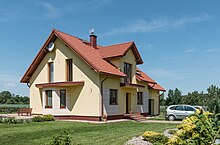
Typical suburban single-family unit house in Poland

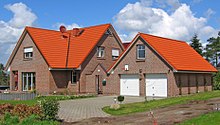
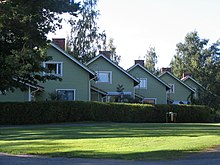
Typical Finnish post-World War Two single-family houses in Jyväskylä
Terms corresponding to a single-family discrete abode in common use are unmarried-family home (in the US and Canada), single-detached dwelling (in Canada), detached house (in the United Kingdom and Canada), and separate firm (in New Zealand).[ citation needed ]
In the United kingdom, the term single-family abode is almost unknown, except through Net exposure to U.s.a. media. Whereas in the US, housing is usually divided into "single-family homes", "multi-family dwellings", "condo/townhouse", etc., the main division of residential property in British terminology is between "houses" (including "discrete", "semi-detached", and "terraced" houses and bungalows) and "flats" (i.east., "apartments" or "condominiums" in American English).[ commendation needed ]
History and distribution [edit]

In pre-industrial societies, well-nigh people lived in multi-family dwellings for most of their lives. A kid lived with their parents from nascency until marriage, and and so generally moved in with the parents of the homo (patrilocal) or the woman (matrilocal), so that the grandparents could help raise the young children and so the middle generation could intendance for their crumbling parents. This type of organization also saved some of the effort and materials used for construction and, in colder climates, heating. If people had to move to a new place or were wealthy enough, they could build or buy a domicile for their own family unit, but this was not the norm.
The idea of a nuclear family living separately from their relatives as the norm is a relatively recent development related to rising living standards in Northward America and Europe during the early on modern and modern eras. In the New Globe, where land was plentiful, settlement patterns were quite different from the shut-knit villages of Europe, meaning many more people lived in large farms separated from their neighbors. This has produced a cultural preference in settler societies for privacy and infinite. A countervailing trend has been industrialization and urbanization, which has seen more than and more people effectually the earth movement into multi-story apartment blocks. In the New Earth, this type of densification was halted and reversed following the Second Earth War when increased car ownership and cheaper building and heating costs produced suburbanization instead.
Single-family unit homes are at present common in rural and suburban and fifty-fifty some urban areas beyond the New Globe and Europe, every bit well as wealthier enclaves within the Third World. They are most common in low-density, loftier-income regions. For example, in Canada, according to the 2006 census, 55.3% of the population lived in single-detached houses, only this varied substantially by region. In the city of Montreal, Quebec, Canada's 2d-most populous municipality, just 7.5% of the population lived in single-discrete homes, while in the city of Calgary, the tertiary-most populous, 57.8% did.[3] Note that this includes the "urban center limits" populations only, non the wider region. Culturally, single-family unit houses are associated with suburbanization in many parts of the world. Owning a home with a yard and a "white sentry debate" is seen every bit a fundamental component of the "American dream" (which too exists with variations in other parts of the world).[4]
In the 21st century, a lack of affordable housing, the climate alter impacts of urban sprawl, and concerns nearly racial inequality has increasingly led cities to abandon single-family housing in favor of higher-density homes.[4] [5]
Separating types of homes [edit]
House types include:
- Cottage, a small firm. In the US, a cottage typically has four master rooms, two either side of a fundamental corridor. It is common to find a lean-to added to the back of the cottage which may accommodate the kitchen, laundry and bathroom. In Australia, information technology is common for a cottage to take a verandah across its front. In the UK and Ireland, any small, former (peculiarly pre-Earth War I) house in a rural or formerly rural location whether with ane, two or (rarely) three storeys is a cottage.
- Bungalow, in American English this term describes a medium- to large-sized freestanding firm on a generous block in the suburbs, with generally less formal floor plan than a villa. Some rooms in a bungalow typically have doors which link them together. Bungalows may feature a flat roof. In British English, it refers to whatsoever single-storey business firm (much rarer in the UK than the US).
- Villa, a term originating from Roman times, when it was used to refer to a big house which one might retreat to in the land. In the tardily 19th and early 20th centuries, villa suggested a freestanding comfy-sized house, on a big block, generally found in the suburbs. In Victorian terraced housing, a villa was a house larger than the average byelaw terraced business firm, often having double street frontage.
- Mansion, a very large, luxurious business firm, typically associated with exceptional wealth or aristocracy, usually of more than ane story, on a very large block of land or manor.
Mansions usually will have many more rooms and bedrooms than a typical single-family home, including specialty rooms, such as a library, report, conservatory, theater, greenhouse, infinity pool, bowling aisle, or server room.
Many mansions are too large to be maintained solely by the owner, and as such there volition be maintenance staff. This staff may too live on site in 'servant quarters'.
Run into also [edit]
- Semi-detached
- Unmarried-family zoning
References [edit]
- ^ "Spending Patterns in Canada: Data quality, concepts and methodology: Definitions". www.statcan.gc.ca.
- ^ "Saitta House – Report Function i Archived 2008-12-16 at the Wayback Machine",DykerHeightsCivicAssociation.com
- ^ Canada, Regime of Canada, Statistics. "Statistics Canada: 2006 Community Profiles". www12.statcan.ca.
- ^ a b Dillon, Liam (May 13, 2019). "California could bring radical modify to single-family unit habitation neighborhoods". Los Angeles Times . Retrieved 2019-05-13 .
- ^ "The Upzoning Moving ridge Finally Catches Up to California". Bloomberg.com. 1 March 2021. Retrieved 2 March 2021.
External links [edit]
- "Australian Housing Types" (PDF). Your House instructor resource kit. Royal Australian Institute of Architects. Archived from the original (PDF) on 2006-06-26. Retrieved 15 January 2006.
Source: https://en.wikipedia.org/wiki/Single-family_detached_home
0 Response to "Single House Family for Sale in Chicago Il"
Post a Comment